
We asked Erik Janssen Steenberg, Business Development Manager at Bleckmann Logistics (The Netherlands).
The European Union is changing the way product information will travel through the supply chain. Under the Ecodesign for Sustainable Products Regulation (ESPR), the Digital Product Passport (DPP) will provide digital access to relevant information about products, materials and their lifecycle. Textiles and apparel are among the priority product groups, although the detailed requirements for the sector still need to be defined through a specific delegated act.
For Peruvian exporters of wool, alpaca and other textile products, this raises two obvious questions: should we be worried, and will it be expensive?
Is there any reason to worry?
Not necessarily, but exporters should start preparing.
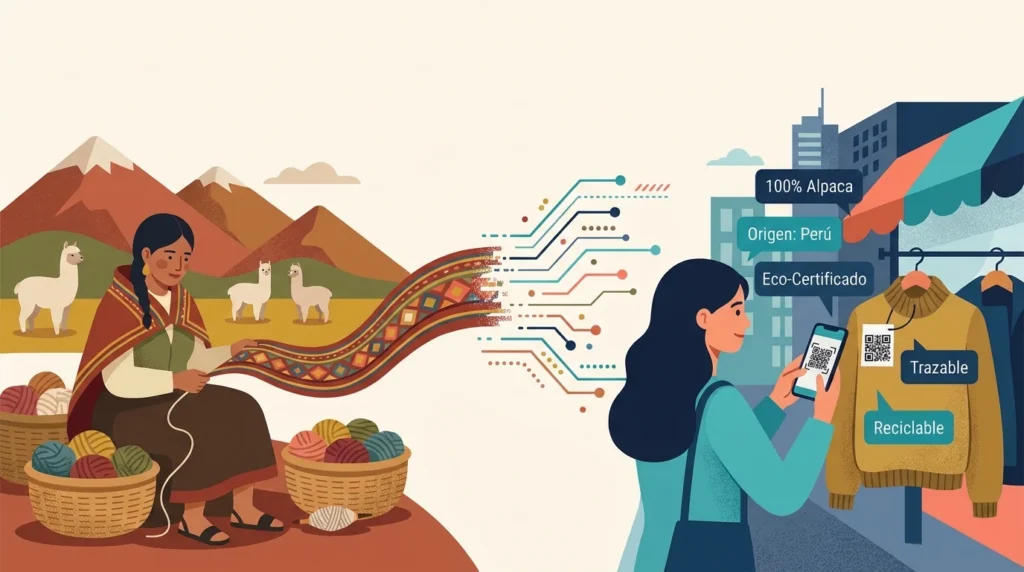
The DPP should be seen first as a traceability and information standard, rather than an impossible new barrier to the European market. The exact textile data requirements are not yet final. Potential information may include product identification, fiber composition, manufacturing information, environmental information and details supporting repair, reuse and recycling.
This could actually favor producers who can substantiate the story behind their products. For Peruvian companies with strong knowledge of fiber origin, manufacturing processes and craftsmanship, greater transparency can become an advantage rather than simply a compliance cost.
Organizations that start investing early in data quality, supply chain visibility and digital product information can be better prepared for future requirements and better placed to demonstrate the sustainability and circularity of their products to customers.
But the challenge is that this information needs to be reliable, structured and capable of moving between companies and systems.
How affordable is it?
There will be costs. Companies may need to improve master data, digitize information that today sits in spreadsheets or documents, adapt systems and agree how information is exchanged with customers.
The cost will vary from company to company. Company size and export volumes can influence the budget, but they are not the only factors: the number of product lines and suppliers, the quality of existing data and the systems that need to be connected also matter. Providers may charge a recurring platform fee, a usage-based fee, or both, so exporters should compare setup costs and ongoing charges against their own product range and expected volumes rather than assume a standard cost per shipment.
But the more important question may be: what will it cost not to be ready?
DPP obligations will apply to products covered by the relevant legislation when they are placed on the EU market, including imported products. In practice, European customers are therefore likely to need increasingly structured information from their international supply chains.
Another important subject is data governance. Who creates the information? Who owns it? Who is allowed to change it? And who is responsible when information provided upstream is incorrect? Before investing heavily in technology, Peruvian exporters should agree these responsibilities with their suppliers and European customers, involving the importer or other operator responsible for placing the product on the EU market. A practical starting point is to bring together the people responsible for product data, sourcing, compliance and IT to agree who provides, verifies and updates each data element.
What can exporters do now?
- Map the product data you already have: fiber composition, origin, production locations, technical specifications and certifications.
- Identify the gaps: what information would be difficult to provide today?
- Clarify ownership: agree with suppliers and customers who creates, maintains and verifies each data element.
- Improve product identification: make sure physical products and reliable digital information can remain connected throughout the supply chain.
- Start small: test the approach with one product range or European customer before making major technology investments.
The longer-term opportunity goes beyond compliance. During returns, repair and recommerce, reliable product information may help identify a product and its materials, while physical inspection determines its actual condition and next destination. This was one of our central conclusions during a recent DPP discussion at the ISPO event in Amsterdam.
The DPP should therefore not only trigger the question “How do we comply?” For Peruvian exporters, the better question may be:
“How can better product information strengthen our position in the European value chain?”
Sources
- European Commission, Digital Product Passport.
- European Commission, Textile Apparel and the Digital Product Passport (accessed November 24, 2026).
- European Commission, DPP for Economic Operators.
- GS1, Textiles and Apparel DPP materials.
- ISPO 2026 panel discussion: From Compliance to Commercial Asset – Making DPP Pay for Itself.
- Renoon, The Cost of a Digital Product Passport Solution: Key Factors of Influence (provider guidance on cost drivers; accessed November 24, 2026).
Author details:
Erik Janssen Steenberg | Business Development Manager | Bleckmann | erik.janssensteenberg@bleckmann.com